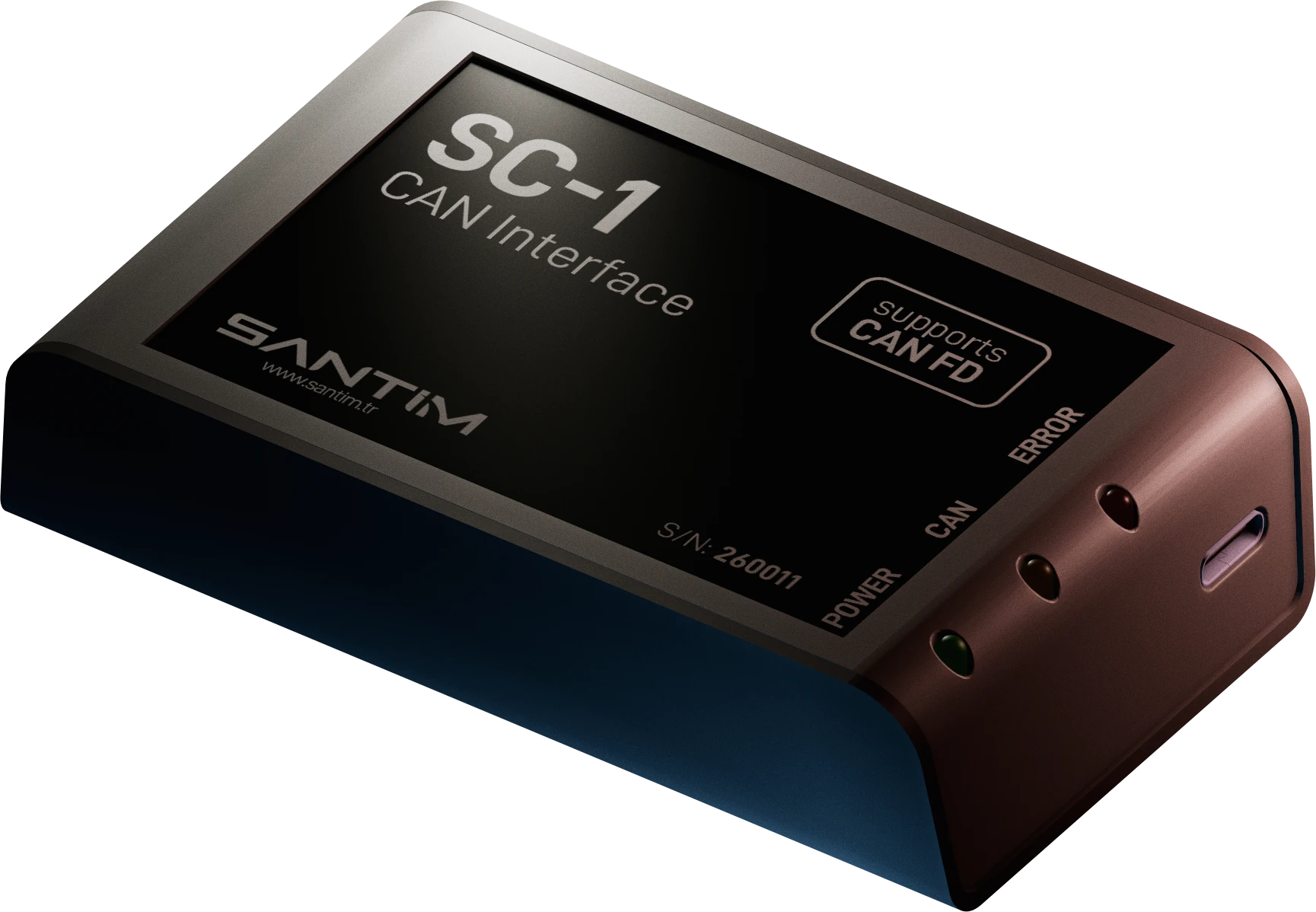
What is CAN bus?
Controller Area Network (CAN) is the communication backbone of modern vehicles. Developed in the 1980s, it lets electronic control units — powertrain, brakes, airbags, instrument cluster — exchange messages over a shared two-wire network, without a central computer.
- Two-wire differential bus (CAN High and CAN Low)
- Message-based, multi-master communication
- Built-in error detection and fault confinement
- Standardized in ISO 11898
How CAN communication works
Every message carries an identifier that also defines its priority. When two nodes transmit at the same time, the message with the lower identifier wins arbitration — without corrupting the data. Time-critical messages always get through first.
- 11-bit (standard) and 29-bit (extended) identifiers
- Non-destructive bitwise arbitration
- Up to 8 data bytes per frame in Classic CAN
- Typical bit rates from 125 kbit/s to 1 Mbit/s
Classic CAN vs CAN FD
CAN FD (Flexible Data-rate) is the evolution of Classic CAN. It keeps the same arbitration principle but allows larger payloads and a faster data phase — and newer vehicles use it more and more.
- Up to 64 data bytes per frame instead of 8
- Faster data phase, often 2–5 Mbit/s
- Stronger CRC for longer frames
- Classic CAN and CAN FD often coexist in one vehicle
OBD-II and SAE J1939
OBD-II is the standardized diagnostic interface of passenger cars; on CAN-equipped vehicles it runs over ISO 15765-4. SAE J1939 is a higher-layer protocol used in trucks, buses and agricultural machinery.
- OBD-II: 16-pin connector, mandatory in the EU since the early 2000s
- ISO 15765-4: diagnostics over CAN
- SAE J1939: 29-bit identifiers, typically 250 or 500 kbit/s
- J1939 defines parameter groups for heavy-duty vehicles
Network topology
A CAN network is a linear bus terminated at both ends with 120 Ω resistors. Many vehicles run several CAN networks — powertrain, body, infotainment — linked through gateways.
- 120 Ω termination at each end of the bus
- Twisted-pair wiring for noise immunity
- Multiple buses connected through gateways
- Diagnostic access through the OBD-II connector
Where CAN bus interfaces are used
Aftermarket devices often need vehicle information such as speed or ignition state. A CAN bus interface provides it in a clean, standardized way.
- Taximeters
- Navigation and fleet telematics
- Parking sensors and cameras
- Speed limiters and retrofit systems
Choosing a CAN bus interface
Look for broad vehicle compatibility, support for both Classic CAN and CAN FD, clear status indication and simple management.
- Support for Classic CAN and CAN FD
- Compatibility across brands and model years
- Visible status indication
- Straightforward setup and support
At a glance
How the most common CAN-based standards compare.
| Classic CAN | CAN FD | OBD-II (ISO 15765-4) | SAE J1939 | |
|---|---|---|---|---|
| Typical use | In-vehicle networks | Newer in-vehicle networks | Passenger-car diagnostics | Trucks, buses, machinery |
| Payload per frame | 8 bytes | Up to 64 bytes | 8 bytes | 8 bytes (multi-packet possible) |
| Bit rate | Up to 1 Mbit/s | Up to 5+ Mbit/s data phase | 250 / 500 kbit/s | 250 / 500 kbit/s |
| Identifiers | 11 / 29-bit | 11 / 29-bit | 11 / 29-bit | 29-bit |
| Standard | ISO 11898-1 | ISO 11898-1:2015 | ISO 15765-4 | SAE J1939 |
Glossary
- ECU
- Electronic Control Unit — a computer that controls one vehicle function, such as the powertrain or brakes.
- Arbitration
- The process that decides which node may transmit when several start at the same time.
- Termination
- 120 Ω resistors at both ends of the bus that prevent signal reflections.
- DLC
- Data Length Code — the field that states how many data bytes a frame carries.
- Gateway
- A unit that connects separate vehicle networks and forwards messages between them.
- OBD-II
- On-Board Diagnostics — the standardized diagnostic connector and protocol of passenger cars.